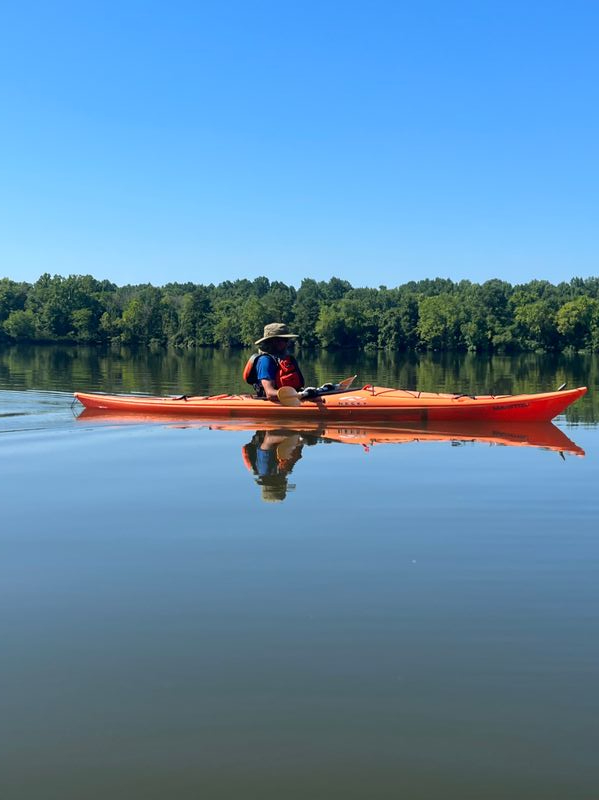
I am going to start this post off explaining what this trip meant – the why if you will. I like to trek and I feel very comfortable in fresh water. I wanted a challenge so I looked at the ICW. Of course a salt water trip added the challenge of, the corrosiveness of salt water and then the fresh water requirements. I am NOT a fan of the ocean – nice place to visit but not to live in/on. During my 2023 trip I found out how much of a challenge those two pieces really are. I was able to adjust this trip to accommodate the fresh water issue by getting different more flexible water storage bottles. They worked very well and that meant less stuff on the top of the kayak that caught the wind. As far as the corrosiveness I made sure to keep things away from the salt water as much as possible; knives in plastic bags, fresh water rinses as much as possible… Those preventative processes helped but salt water is just what it is and you have to be attentive to that issue.
The second challenge was; the ICW is not a planned route for canoeists or kayakers. It is mapped/planned when you travel by sail or motor boat where you can stay aboard the boat, but not for the kayak/canoe campers. There are many different moorings that work for the boating community but not well for those of us that have to camp. Google earth became my means of locating places to stay. When you look at Google Earth you will see may islands/peninsulas where they look like donuts (roundish islands with a white center) that are camp able. These islands are formed when the channel is dredged, the waste makes these islands/peninsulas. The tides bring the organic material to the the shores of these places where trees start to grow, making the donuts. I never ran into problems using these spaces, and there is plenty of evidence that others use these spaces regularly (too much trash left behind). Of course Google Earth isn’t perfect however, it is a great resource.
As you zoom in and out of Google Earth you may find (as I did occasionally) camp sites/grounds. Through the NPS (National Park Service App) I was able to reserve some of these sites. I stayed in the Cape Canaveral Nation Seashore on an island for $20 per night. I have recently found a NPS campsite in Georgia and it is $9 per night. But these are few and far between. I also found Florida state parks (using their web site), as well as some county parks using Google Earth; they were very comfortable and felt safe. Just bring a means to secure your kayak to a tree or fence, and a pack to transport your gear to your assigned site. The state and county parks have needed services (laundry, showers and fresh water) that make your trip more comfortable. The campgrounds made it possible for me to travel relatively inexpensively. Hotels, Inns and the like can get pricey quickly. I went 19 days with out having four walls around me, and still felt safe and comfortable on this trip.
So there is the why and some of the solutions, now for the lessons learned:
Well, I have been home for close to a week now and doing my lessons learned. I know in my last post I blamed the weather as the deciding factor for stopping. Well that is only a part of the story. There were three different factors I took into consideration.
- First there was the weather. Winds and rain were being predicted to be a factor 3-4 days per week for the foreseeable future. I had anticipated weather issues but that was more than I bargained for.
- Using Google Earth I would look for possible stopping points starting at 15 miles to 20 miles; knowing that would be my limits each day. Well after leaving Florida it was becoming increasingly difficult to find stopping points. I had friends and relatives that had volunteered to put me up in Georgia but they were 54 miles apart. Starting in Jacksonville Fl. the shores were more marshy, or grassland rather than the required forested areas or even just hard ground. Google Earth through Georgia is poor quality pictures, so just finding the route was a challenge. I then had to depend more on my Navionics app., however I wanted Google earth to assist me in finding short cuts. Smaller not normally navigable paths that allowed me (with a 14-16 inch draw) to cut out some of the meandering channel. The images weren’t detailed enough to distinguish between waterway and grassland/marsh.
- My support team (mainly my wife – but my brother and cousin too) either work or had engagements that would leave me without any immediate assistance. Not a major issue; as I would hole up somewhere if push came to shove. But I was getting a distinct message (without it being stated directly) that I was wanted back home.
The expectation for this trip was of course to be a “fun” trip; work, yes but mostly fun. So with these three factors I made the decision to pull the plug. My wife Peg and I have some interesting trips planned that I hope to post here later this year.
As for some facts and muses:
- When I was getting in shape for this trip I counted my strokes per mile. The average of that turned out to be 676 strokes per mile. So you can do the math when I was traveling 15 to 20 miles per day.
- This year I completed 139 nautical miles from Melbourne Beach to St. Augustine (I used my Navionics app to get that number). On the 2023 trip 168 miles from Miami to Melbourne Beach. So a grand total of 307 miles or 207,532 strokes.
- Many folks found this as an interesting fact. It took me 2-3 hrs each morning to get on the water. I would wake at 5am and hardly ever got on the water before 8am. Why? Well because when you arrive each day at your campsite, you needed to get the kayak above the high water mark (plus high enough to account for a wake from passing boats). That normally meant emptying the kayak – move the kayak – then putting stuff back in to keep the critters away from it. Then each morning there is breakfast, breaking camp, emptying the kayak, getting it near the water, repacking the kayak before you can actually get on the water. Note: I am not a morning person so I don’t move fast before coffee. The one time I did act fast and leave prior to 8, I left my tarps behind.
- Losing equipment (tarps) was an unexpected issue. One of the tarps was part of my hammock set-up, the other was to give me space to hang out in if weather bound. I did however have a tent I could use rather than my preferred hammock. But as stated the hammock was preferred so, I purchased a new tarp of equal size to continue the use of the hammock. However it was the typical blue tarp (found in hardware stores) vs SiNylon (Silicone infused nylon) tarps. The difference was that two SiNylon tarps packed down to the size of 5 softballs vs the blue tarp which folded to a 10 by 24 by 5 inch bundle. The SiNylon was able to pack inside the kayak; but the blue tarp had to be packed atop the kayak. Not the preferred method, as it added “sail” to your kayak and during winds that is an definite problem. Not to mention, I now didn’t have a place to hang out in.
- Lastly, I am not a reader so I didn’t bring books to read during down time. I admit I am addicted to my screens. However, that means using power, and your down time is normally not when the solar power is available (overcast, rain…); so to conserve power I had to stay off the screens. My lesson learned here is: if and when I try something like this again I need to bring something to occupy my down time. In fresh water I would normally fish or carve wood, but the salt water corrosiveness and space issues kept me from brining those items.
Well I hope this post made sense, and was informative. I plan on adding a page in the next few days to describe how I deal with food and staying healthy.
Thanks again for following. I hope to see you in the near future


2 responses to “Muses – Facts and stuff”
Glad you’re safely back home. I enjoyed following your trip!
LikeLike
I admire your courage. I have thoroughly enjoyed reading of your BIG Adventure! Look forward to the documentation of your family trips as well!
LikeLike